
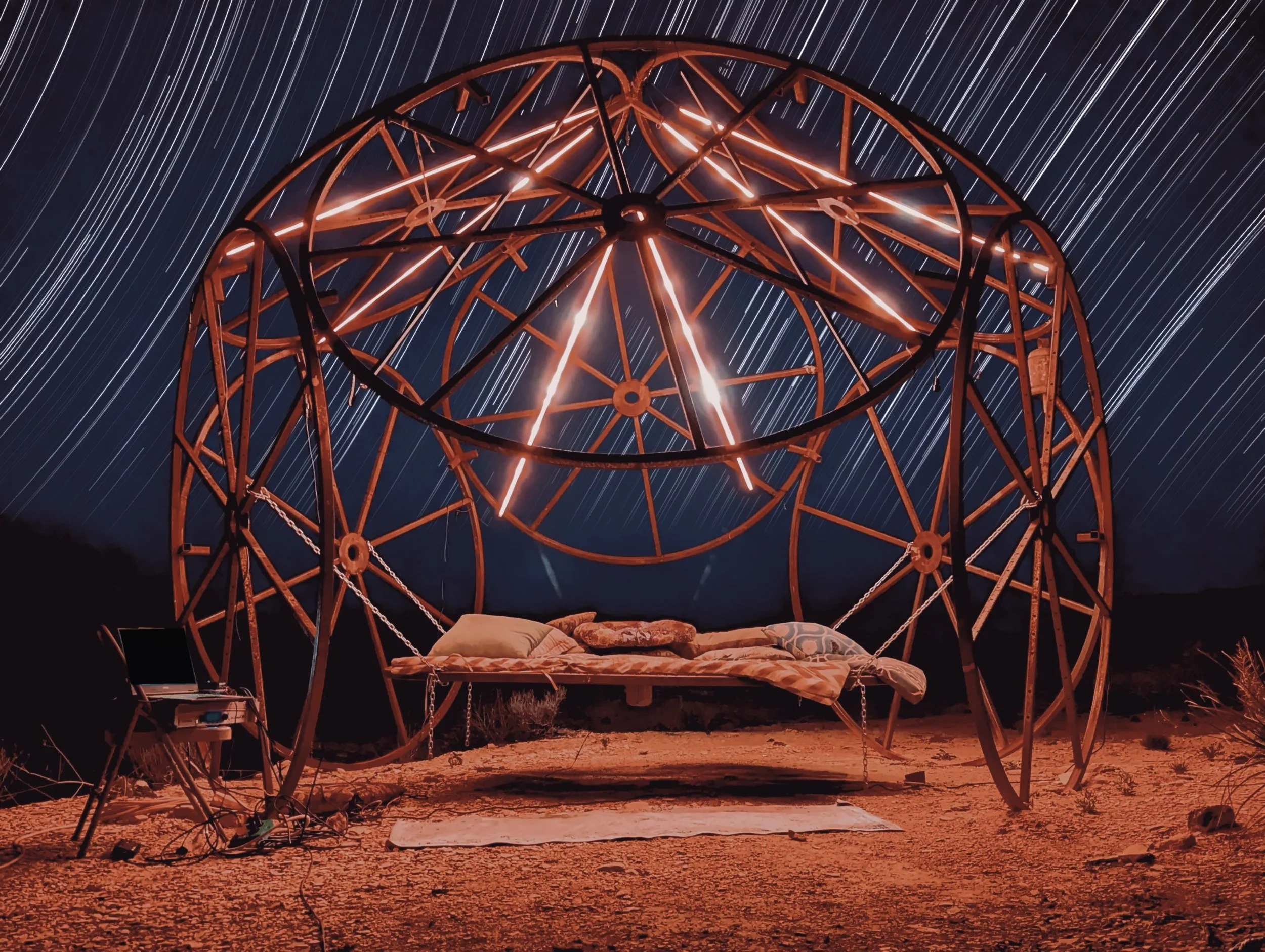
The social pod at Villa Magora after dark. Photo: John Gennusa.
A circle hung from chains
On the open desert at Villa Magora, near Terlingua, Texas, stands a lattice dome of steel rings. Inside it, an eight foot circular platform hangs from chains, piled with cushions and pillows. Pixel mapped LEDs trace the frame and glow low and warm after dark.
I call it a social pod: a round space where four to eight people can gather, face each other and get as comfortable as they need to be. It sways a little when someone climbs in, and conversations there tend to run long.
The rings came from steel cable spools, the big reels that carry wire, tubing or, in this case, fibre optic line. Contractors had left them behind around our community, so we decided to give them a second life. I had always wanted to build a social pod in the shape of a dodecahedron. Once I got my hands on the spools and hauled them to Villa Magora, I got to welding.
Round, soft places to gather are far older than this one. Nearly every culture has built some version of them, and the science behind their pull is richer than I expected.
An old idea in many forms
People have been building versions of this space for as long as there have been people. Here are five of them, oldest first.
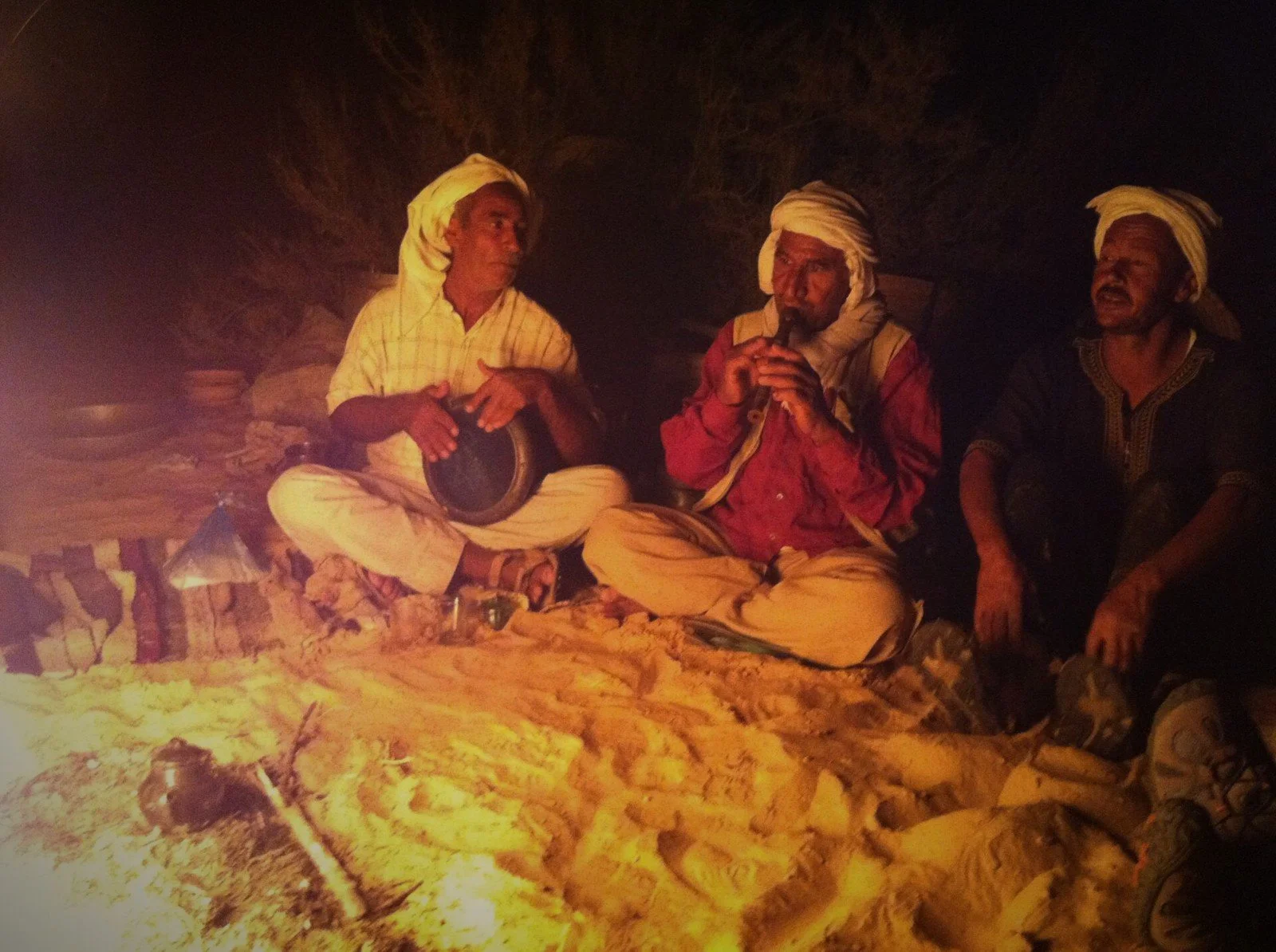
Music around a campfire in the Sahara.
The hearth circle. The first social pod was a fire. Some sites in Africa hint at fire use as early as 1.6 million years ago, though that evidence is debated; in Europe, habitual fire use shows up from about 300,000 to 400,000 years ago, according to a review by archaeologists Wil Roebroeks and Paola Villa. Ever since, people have ended the day in a ring of faces with darkness at their backs.
Anthropologist Polly Wiessner spent time in that ring. In 1974 she lived with Ju/'hoansi (!Kung) foragers in the Kalahari, in northeast Namibia and northwest Botswana, and took notes on 174 conversations, some by day and some by firelight. Decades later she returned to those notes, added 68 translated texts, and published the comparison in PNAS in 2014.
On most nights, she found, a camp of up to fifteen people drifts away from its separate family hearths and gathers at a single fire. The talk there differs from anything said in daylight. By day, people discussed work, food, where resources could be found, and the criticism and complaints that keep a camp in line; stories made up only about 6 percent of daytime talk. At night, around 81 percent of conversation was storytelling: past hunts, quarrels over meat, people living in distant camps, and the spirit world.
Wiessner's explanation centres on the light. By day we read each other's faces constantly. By the fire, people mostly gaze into the flames, expressions fall into shadow, and awareness of self and others softens. As she put it, "people are much more open at night by a fire."
In a commentary published alongside her paper, evolutionary psychologist Robin Dunbar described what firelight gave our ancestors: hours after sunset when no productive work could be done. Those hours went to conversation, storytelling and singing, the slow work of bonding a group. The hearth circle may be where much of human sociability took shape.
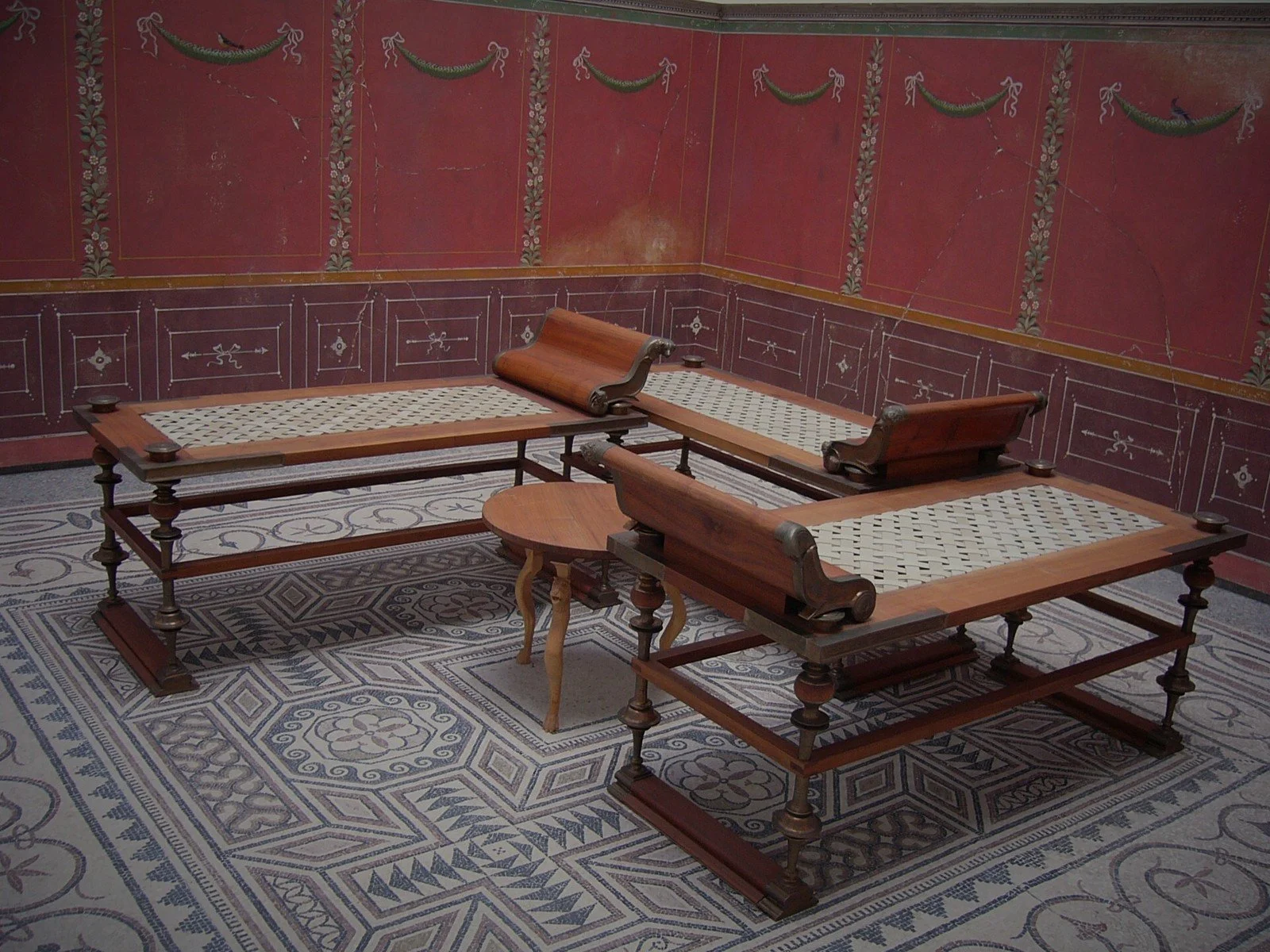
A reconstructed Roman triclinium, Munich.
The Roman triclinium. Wealthy Romans dined lying down. Three couches stood in a U around a low table, usually three guests to a couch, each propped on the left elbow. Every guest stayed within easy speaking distance. Dinners ran for hours, and the conversation mattered as much as the food. The scholar Marcus Varro even put a number on it. As Aulus Gellius records, Varro held that a dinner party should have no fewer guests than the three Graces and no more than the nine Muses, because a bigger crowd turns disorderly. A pod built for four to eight sits right inside his range.
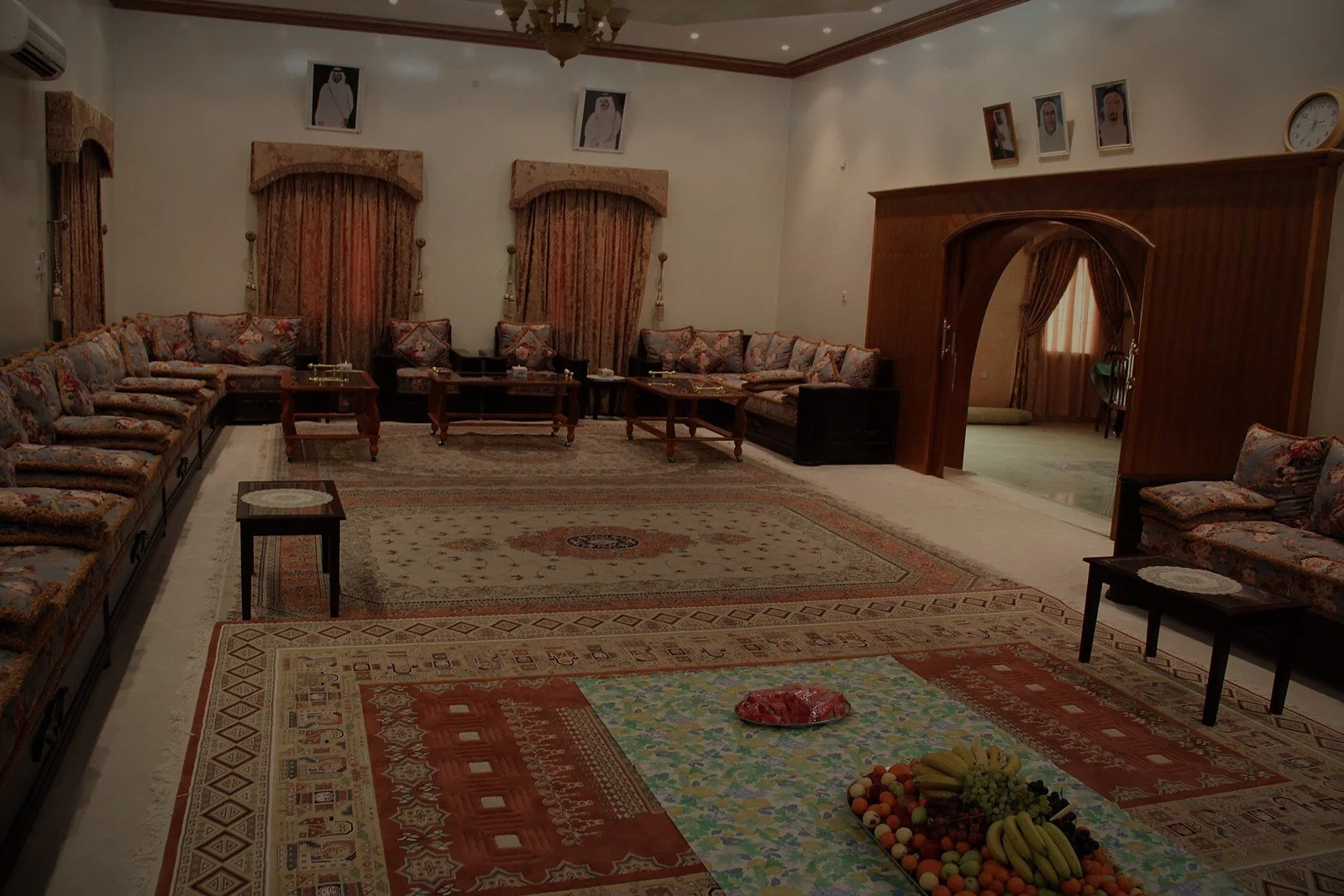
A traditional majlis in northern Qatar.
The Arab majlis and the Ottoman sedir. Majlis means "a place of sitting." Carpets cover the floor, cushions line the walls, and every guest faces the centre, where coffee is prepared and served. The community gathers there to settle problems, offer condolences and hold wedding receptions, and to pass on folk stories, songs and poetry. In 2015 the United Arab Emirates, Saudi Arabia, Oman and Qatar had the majlis inscribed on UNESCO's list of the Intangible Cultural Heritage of Humanity. Ottoman homes built the same idea into their walls as the sedir, a raised cushioned bench running around the room.
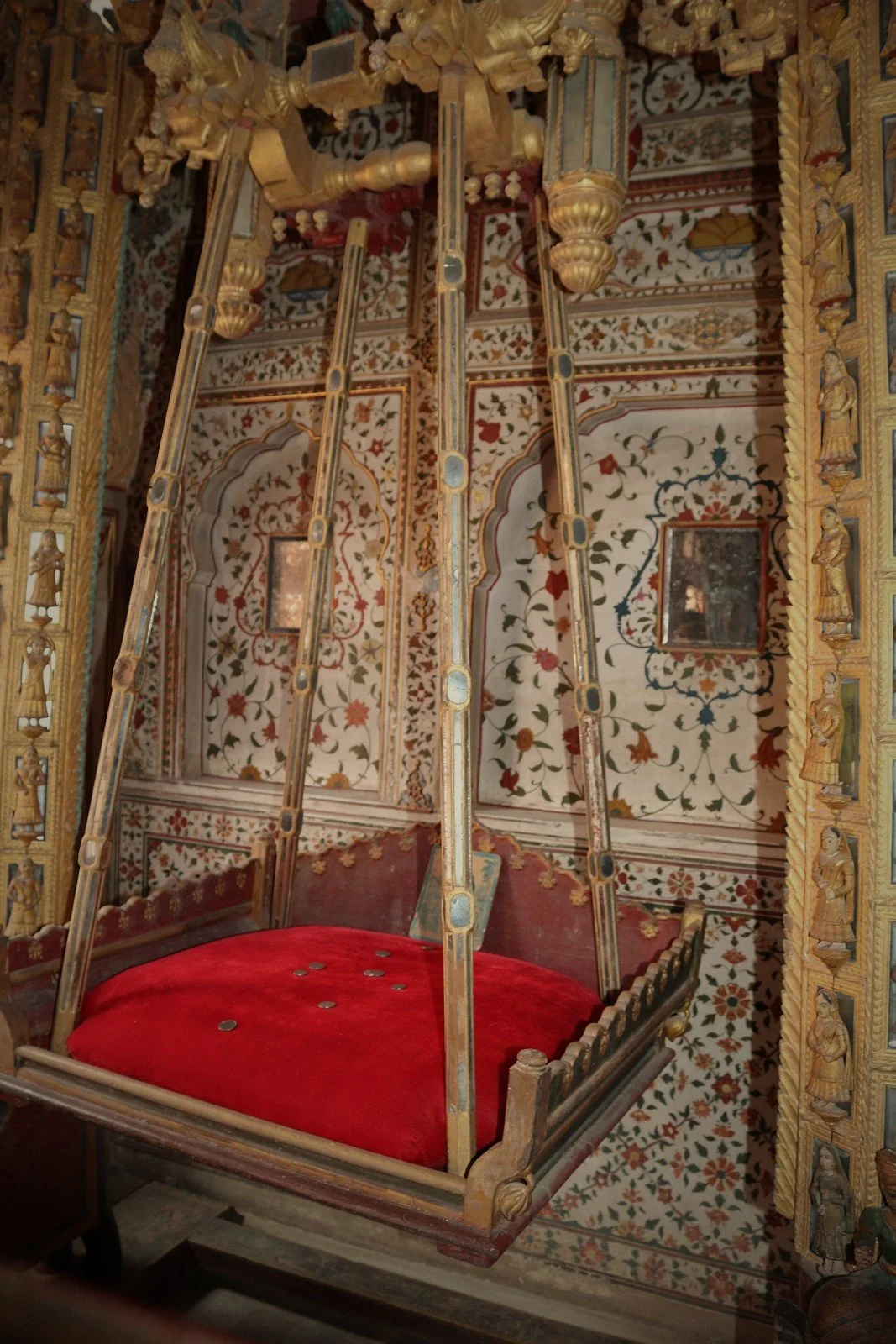
A royal swing at Junagarh Fort, Rajasthan, a cousin of the hindolo.
The Gujarati hindolo. In the courtyard homes of Gujarat, India, a wooden swing bed hangs on chains from the beams of a veranda or front room. Family and visitors sit side by side, swaying with a push of the foot, talking through the hot afternoons and into the evening. Of every tradition here, it comes closest to our pod: a platform on chains that keeps everyone gently moving together. Across most of Gujarat this swing is called a hichko; in the Saurashtra region it is the hindolo, from the Sanskrit word for a swing. Some are as long and wide as a single bed, and most seat two to four people. Many have a backrest that pivots on the armrests, so the people on it can turn to face either way, and ornate ones hang from brass chains cast with parrots, peacocks and elephants.
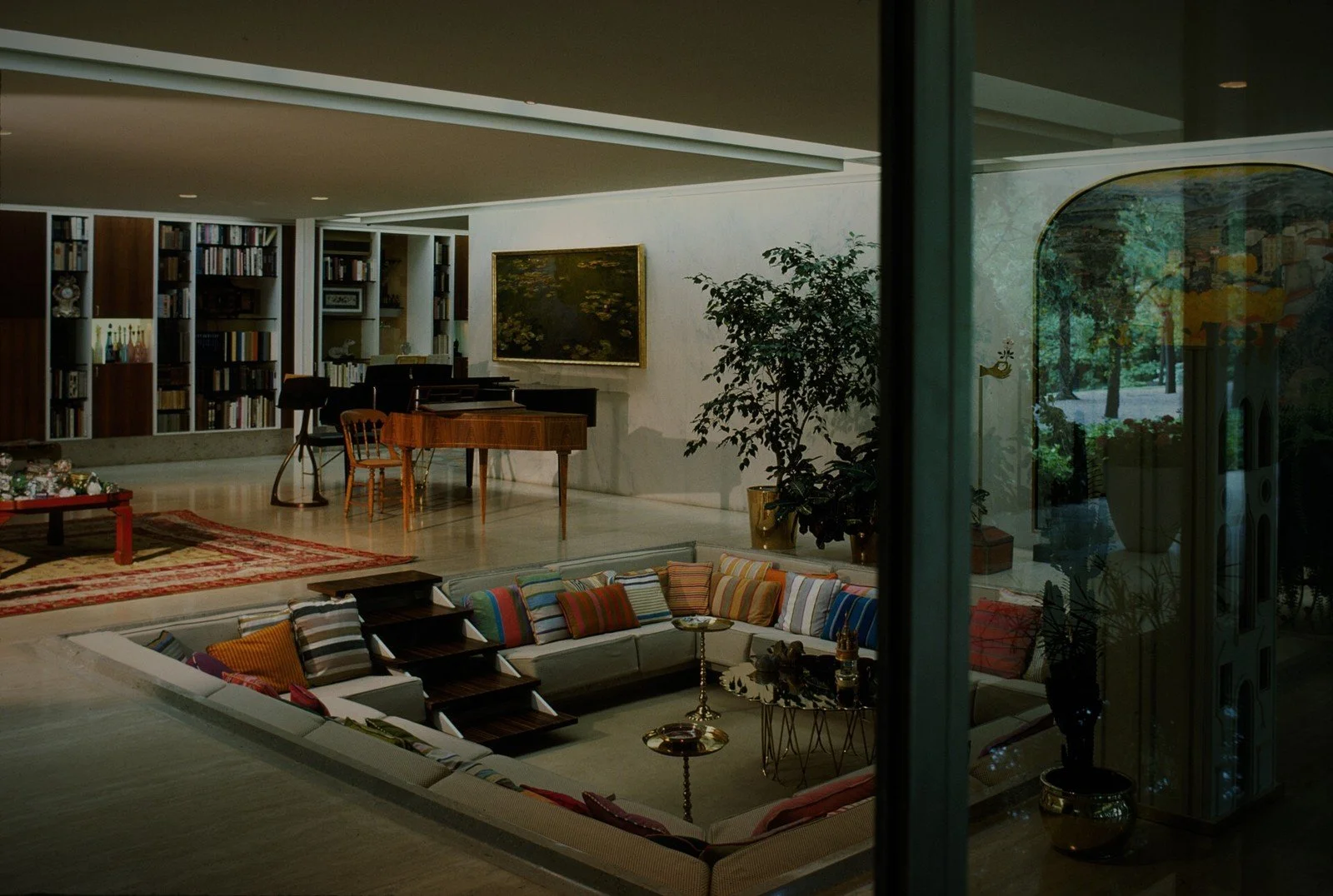
The conversation pit at the Miller House, Columbus, Indiana.
The conversation pit. In the 1950s, architect Eero Saarinen and designer Alexander Girard sank a cushioned square, about fifteen feet across and two and a half feet deep, into the living room floor of the Miller House in Columbus, Indiana. A twenty page House & Garden feature in 1959 made it famous, and pits spread through modernist homes in the 1960s and 1970s. They later fell out of fashion, partly because they were awkward and a little hazardous; at the Millers' own cocktail parties, late staying guests tended to fall in. For a couple of decades, though, American living rooms were organised around a sunken ring of cushions where everyone faced each other.
The same ingredients keep returning across these traditions: a shared centre, soft surfaces, bodies low and level, warmth, and light kept dim.
Why the circle
Psychiatrist Humphry Osmond named this kind of space in the 1950s while running a hospital in Saskatchewan. He noticed that some layouts, like railway waiting rooms, keep people apart; he called them sociofugal. Others, like café tables and diner booths, draw people together, and he called those sociopetal.
His colleague Robert Sommer spent a decade studying the idea. His 1969 book Personal Space: The Behavioral Basis of Design helped found the field of environmental psychology.
The shape itself seems to matter as well. In a 2013 study in the Journal of Consumer Research, Juliet Zhu and Jennifer Argo seated people in circular or angular arrangements. Circles primed a need to belong, while angles primed a need to be unique. The effect is subtle and was measured through reactions to advertising, so I read it as a hint, and one that agrees with every tradition above.
Size plays a part too. Robin Dunbar, N. D. C. Duncan and Daniel Nettle counted freely forming conversation groups in public places and found an upper limit of about four people who can share one spontaneous conversation. A pod built for four to eight fits that ceiling: four people hold a single conversation, and eight have room to split into two and come back together.
So does height. Psychologist Thomas Schubert found that people read vertical position as a cue to power, judging whoever appears higher up as more powerful. On the pod everyone sits at the same level, so nobody looks down on anyone else.
Why the light stays low
The Kalahari fires suggest that light shapes a gathering as much as layout does, and fire may calm the body too. Anthropologist Christopher Lynn measured blood pressure in 226 adults watching simulated fires. Fire with its crackling sound lowered blood pressure, more so with longer viewing, and the effect was strongest in people who scored higher on prosociality. A silent fire did not have the same effect.
Darkness changes how we think as well. Psychologists Anna Steidle and Lioba Werth found that people working in dim light (150 lux) felt freer from constraint and solved more creative insight problems than people under bright light (1,500 lux).
For the pod, all of this argues for light that stays warm, low and slowly shifting: something to watch besides each other's faces, and the nearest thing to a hearth that LEDs can offer. It also suits the land, where Villa Magora already keeps to red light at night.
Why it moves
Because the pod hangs, everyone on it rocks together. Researchers at the University of Connecticut, Colby College and the College of the Holy Cross, led by Michael Richardson, built a "rocking chair paradigm" to study this kind of shared motion. Pairs seated side by side fell into sync without being asked, even when their chairs had different natural rhythms. Later work tracked groups of six rocking in a circle facing the centre.
Shared rhythm matters because it seems to build liking. Michael Hove and Jane Risen (2009) found that the more closely people tapped in time with an experimenter, the more they liked that person afterwards. Miriam Rennung and Anja Göritz later pooled 60 experiments in a meta-analysis and found a medium sized effect of synchrony on prosocial attitudes and behaviour.
Rocking chairs let each person drift into sync on their own. A hanging platform couples everyone into a single motion from the first moment, so the group sways as one body.
What the pod is teaching us
I often see people gravitate to the pod to relax and talk, as if this kind of connection were written into our DNA. The research above agrees with what people around the world worked out long before anyone took measurements. A shared centre, soft surfaces, bodies low and level, warm dim light and gentle shared movement all draw people closer.
The pod is our attempt to put those old ingredients together in one place, under a desert sky. We will keep watching how people use it, and what the swaying platform does that a ring of chairs cannot.
Join us at Villa Magora
The best way to understand a social pod is to sit in one with good company. Every Monday through mid-April, we hold Co-Labs at Villa Magora: community work on the land, followed by a pizza night and shared dinner. Come lend a hand, stay for a slice, and meet your neighbours around the table.
Keep an eye on our calendar at themagoraproject.com for Co-Labs, events and gatherings, and join our mailing list to hear about them first.
If you would like to support this work, you can make a tax deductible donation. The Magora Project is a fiscally sponsored project of The Method Project, a Wyoming 501(c)(3), and you can give at give.themethodproject.org/themagoraproject. Gifts fund research, Co-Labs, ecological monitoring nodes and community projects like this one.
Sources
Roebroeks, W. and Villa, P. (2011). On the earliest evidence for habitual use of fire in Europe. PNAS 108(13).
Wiessner, P. (2014). Embers of society: Firelight talk among the Ju/'hoansi Bushmen. PNAS 111(39).
Dunbar, R. I. M. (2014). Commentary on Wiessner: how conversations around campfires came to be. PNAS 111(39).
University of Utah (2014). Firelight talk of the Kalahari Bushmen, press release on Wiessner's study.
UNESCO (2015). Majlis, a cultural and social space. Representative List of the Intangible Cultural Heritage of Humanity.
Quartz (2017). In praise of the conversation pit, on the Miller House and its House & Garden feature.
Osmond, H. and Sommer, R.: sociopetal and sociofugal space; Sommer, R. (1969), Personal Space. Overview.
Zhu, R. and Argo, J. (2013). Exploring the impact of various shaped seating arrangements on persuasion. Journal of Consumer Research. Summary.
Dunbar, R. I. M., Duncan, N. D. C. and Nettle, D. (1995). Size and structure of freely forming conversational groups. Human Nature 6(1).
Schubert, T. W. (2005). Your highness: vertical positions as perceptual symbols of power. Journal of Personality and Social Psychology 89(1).
Lynn, C. D. (2014). Hearth and campfire influences on arterial blood pressure. Evolutionary Psychology 12(5).
Steidle, A. and Werth, L. (2013). Freedom from constraints: darkness and dim illumination promote creativity. Journal of Environmental Psychology. Summary.
Richardson, M. J. et al. (2007). Rocking together: dynamics of intentional and unintentional interpersonal coordination. Human Movement Science 26(6).
Richardson, M. J. et al. (2012). Measuring group synchrony: a cluster phase method. Frontiers in Physiology.
Hove, M. J. and Risen, J. L. (2009). It's all in the timing: interpersonal synchrony increases affiliation. Social Cognition 27, 949 to 960.
Rennung, M. and Göritz, A. S. (2016). Prosocial consequences of interpersonal synchrony: a meta-analysis. Zeitschrift für Psychologie 224(3).
Gellius, A. (2nd century). Attic Nights 13.11, on Marcus Varro and the proper number of dinner guests. Translated by J. C. Rolfe (1927).
Design Innovation and Craft Resource Centre, CEPT University, and SADACC Trust. Vernacular Furniture of North-West India, section on swing seats (hichko and hindolo), shared via Impart.
Photo credits: Sahara campfire, Jnjn1980, CC BY-SA 3.0; triclinium, Mattes, public domain; majlis, Flickr user lawrenceyeah, CC BY-SA 2.0; Junagarh Fort swing, Thérèse Gaigé, CC BY-SA 4.0 (all via Wikimedia Commons); Miller House conversation pit, Balthazar Korab, Library of Congress, no known restrictions. Historical photos were toned darker for this post, and the three CC BY-SA images are shared under the same licences.
